Agentic Vision AI for Smart Manufacturing: The Next Frontier of Defect Detection
Most defect detection systems are reactive by design. Something goes wrong. The AI detects it. A human decides what to do. And the cycle continues.
Agentic Vision AI breaks this cycle. Not incrementally fundamentally. An agentic system doesn't wait for a human to close the loop. It detects the anomaly, evaluates the context, triggers the appropriate workflow response, and then updates its models based on what it learned. All of this happens in milliseconds, across every shift, with zero fatigue.
For smart manufacturing where production lines run 24/7, product variants change frequently, and quality standards tighten every year this isn't a nice-to-have capability. It's the architecture the next decade of manufacturing requires.
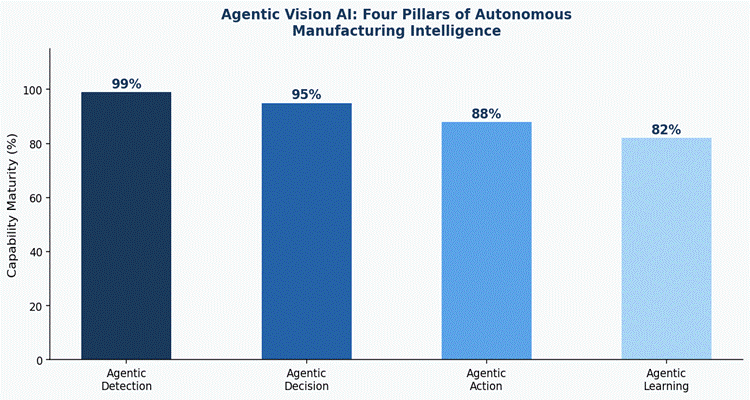
Figure 1: The four pillars of Agentic Vision AI detect, decide, act, learn. Each pillar compounds the value of the others.
Why Standard Defect Detection in Manufacturing Has a Ceiling
Traditional visual inspection even AI-assisted hits a ceiling because it's designed around the assumption that a human is still in the loop. The AI surfaces the signal. The human interprets it. The human routes the response. The human updates the quality protocol.
In a smart manufacturing environment processing thousands of units per hour across multiple shifts, this assumption breaks down fast. Three structural limits become visible:
• Speed ceiling — human decision latency can't match sub-10ms AI inference. By the time a human acts, the defective unit has advanced past the intervention point
• Pattern blindness — cross-shift and cross-line defect patterns that an agentic system would connect in real time take days or weeks to surface through human review
• Learning lag — quality protocols updated by humans after incidents create a permanent gap between what the system knows and what's happening on the floor
Agentic Vision AI eliminates all three. The system detects defects at 99%+ accuracy, makes contextual decisions based on defect type, location, and severity, acts through automated workflow integrations with PLC and MES systems, and continuously self-tunes as production conditions evolve.
AI catches 37% more defects than human inspectors under controlled conditions. An agentic system applies that advantage 24/7 across every shift, every line while simultaneously learning from every detection to improve future performance. |
The Four Pillars of Agentic Vision AI in Smart Manufacturing
Pillar 1 — Autonomous Detection
AegisVision connects to your existing camera infrastructure and begins detecting from day one. No rip-and-replace. Pre-built models for common manufacturing defect taxonomies are included free. Sub-10ms inference enables detection at production line speeds including high-throughput environments running 5,000+ units per hour.
Surface defects. Dimensional deviations. Assembly errors. Missing components. Label and packaging anomalies. The detection library covers the full spectrum of manufacturing quality failures.
Pillar 2 — Contextual Decision-Making
This is where agentic systems diverge from standard Vision AI. A detection isn't just a flag it's a decision input. The system evaluates: what type of defect is this? Where in the production sequence did it occur? Has this pattern appeared before on this line or shift? What's the downstream impact if this unit advances?
Based on this context, the system determines the appropriate response and executes it, without waiting for human instruction.
Pillar 3 — Automated Workflow Action
AegisVision integrates with PLC, MES, and ERP systems through standard connectors. Workflow responses are pre-configured to your quality SOPs. A surface crack triggers a line stop. A label misalignment triggers a routing flag. A dimensional deviation outside tolerance triggers an escalation to the quality manager's dashboard with timestamped evidence, confidence scores, and contextual data attached.
No human needs to be watching the screen. The system acts.
Pillar 4 — Continuous Self-Tuning
An agentic system doesn't stay static. Every detection confirmed defect, false positive, new defect type becomes training data. The system self-tunes continuously, improving accuracy and reducing false alarm rates month over month.
AegisVision's multi-site learning capability extends this further. Best practices and model improvements identified at one facility propagate across all connected sites so your investment in training models at Plant A makes Plant B smarter without additional effort.
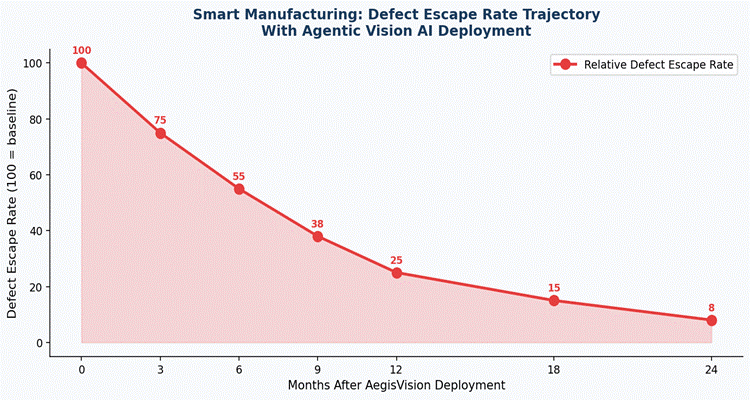
Figure 2: Defect escape rate trajectory post-AegisVision deployment reactive detection transitions to preventive elimination over 24 months.
Smart Manufacturing ROI: What Agentic Vision AI Delivers
Agentic Vision AI — Smart Manufacturing Outcomes | Benchmark |
Defect detection accuracy (ASQ, 2024) | 99.8% |
Additional defects caught vs. human inspectors | +37% |
Defect escape reduction — automotive (Deloitte, 2024) | 83% |
Inspection time reduction | 50–90% |
ROI payback period | 6–12 months |
Multi-site learning propagation time | Days, not months |
Cost of poor quality — industry average (% of revenue) | ~20% |
Line stops response time (automated vs. human) | <10ms vs. minutes |
The math on cost of poor quality is stark. For a $100M revenue manufacturer, 20% cost of poor-quality equals $20M in annual losses from scrap, rework, warranty claims, and customer returns. Agentic Vision AI's 40% defect reduction translates to $8M in recovered margin from a platform with 6–12-month ROI payback. That return compounds as the system moves from Reactive through Predictive to Preventive operations.
The Journey to Preventive Quality Management
Agentic Vision AI doesn't arrive at full capability on day one. The transformation follows the same three-stage journey AegisVision delivers across all deployments but with agentic architecture, each stage compresses.
Stage 1 — Reactive to Detected (Weeks 1–8)
The system connects to existing cameras. Pre-built models begin detecting immediately. Defect escape rates fall as AI catches what human inspection misses. Automated workflow responses replace manual follow-up. Your team starts seeing what was always happening just invisibly.
Stage 2 — Detected to Predicted (Months 3–6)
Patterns emerge across shifts, lines, and production batches that weren't visible before. Process drifts the gradual degradation of conditions that precedes quality failures becomes detectable before defects appear. The system shifts from catching failures to anticipating them.
Stage 3 — Predicted to Prevented (Months 9–18)
Automated workflow responses now trigger on predictive signals, not just detected defects. Compliance is enforced by the system. The quality team focuses on process improvement, not defect investigation. Your cost of poor quality enters structural decline.
AegisVision is a partner for this entire journey not a point solution that you deploy and leave to run. Our team stays through implementation, model tuning, and continuous improvement. That's what makes this a transformation, not a tool purchase. |
Frequently Asked Questions
What makes Vision AI 'agentic'?
An agentic system operates autonomously across the full loop: detect → decide → act → learn. Standard Vision AI stops at detection and alerting. Agentic Vision AI executes workflow responses without human instruction and continuously self-tunes based on outcomes.
Does agentic Vision AI require new cameras or hardware?
No. AegisVision is hardware-agnostic it connects to your existing camera infrastructure. No rip-and-replace. You can be running agentic defect detection in days on your current cameras.
How does multi-site learning work?
Model improvements identified at one facility new defect types, improved detection thresholds, updated process parameters propagate to all connected sites automatically. Best practices spread in days, not the months it typically takes through human-managed knowledge transfer.
Ready to see agentic Vision AI on your production floor? Visit aegisvision.ai to book a walkthrough on your existing cameras, against your defect taxonomy. |
Conclusion
In modern manufacturing environments where production runs continuously and quality standards are constantly increasing, traditional defect detection systems can struggle to keep up. Agentic Vision AI improves manufacturing quality by detecting defects, making contextual decisions, and triggering automated actions in real time.
AegisVision enables this by using AI-powered video analytics on existing production line cameras to autonomously detect defects, automate quality workflows, and help manufacturers move from reactive inspection to preventive quality management.