The Future of Industrial Safety Audits: Video Proof and AI-Based Evidence
Industrial safety audits have a credibility problem. Not because the auditors aren't skilled - but because manual inspection generates a category of evidence that experienced legal and regulatory professionals have learned to question.
A safety officer walks a warehouse floor. They document what they observe. They note compliance and non-compliance. They produce a report. That report is a record of what one person observed on one walkthrough on one day - written in retrospect, filtered through human memory, and with no way to verify what was observed between that walkthrough and the next.
When an incident occurs, this evidence is exactly as defensible as its weakest link. And its weakest link is always the gap between inspection visits.
AI-generated video evidence is different in kind, not just degree. It's continuous. It's timestamped to the millisecond. It's attached to GPS coordinates and asset IDs. It captures what happened, not what a human remembered observing. And it's automatically structured into evidence packs that are compliance-ready from the moment of generation.
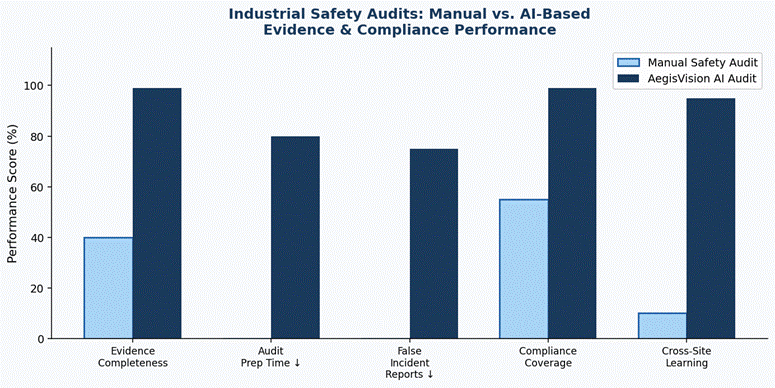
Figure 1: Manual safety audit vs. AegisVision AI-based evidence performance - the gap in evidence completeness and compliance coverage is fundamental.
What Computer Vision in Warehousing Actually Changes
Warehousing and distribution environments are among the most safety-critical in industrial operations. Forklift-pedestrian conflicts. Rack overloading. Slip and fall from blocked walkways. PPE non-compliance in high-traffic areas. These aren't rare events - they're daily occurrences in facilities running at operational capacity.
Manual safety audits sample these environments at intervals. Computer vision monitors them continuously - and generates evidence of every incident, near-miss, and compliance gap, automatically.
Incident Documentation with Video Evidence
When an incident occurs in an Aegis Vision monitored warehouse, the response begins with a complete evidence package: video footage of the incident and the minutes preceding it, AI classification of the incident type, GPS coordinates, shift data, and automated workflow assignment to the relevant safety manager.
No reconstruction. No competing accounts. No ambiguity about what happened. The evidence pack is complete before the first human response arrives.
Near-Miss Detection and Logging
Near-miss events - forklift paths that came within metres of pedestrians, rack loads that shifted without falling, walkways cleared before someone tripped - are detected and logged automatically. Research confirms that up to 80% of near misses go unrecorded in manual systems. AegisVision captures all of them.
This matters enormously for both safety culture and legal liability. A documented near-miss history shows you were aware of a risk condition. A documented near-miss history with evidence of corrective action shows you responded to it. The difference is the difference between demonstrable due diligence and alleged negligence.
Continuous SOP Compliance Monitoring
Factory automation vision extends to SOP compliance - monitoring that equipment safety protocols, PPE requirements, forklift speed limits, and pedestrian zone rules are followed across every shift. Violations trigger immediate alerts and workflow assignments. Compliance rates are tracked by area, shift, and equipment type.
AegisVision detects and documents what manual audit systems miss entirely. Not because auditors aren't thorough - but because 24/7 AI monitoring covers more ground, more consistently, with more complete evidence than any human audit team can sustain. |
From Reactive Audit Trail to Preventive Compliance System
Stage 1 — Continuous Monitoring, Immediate Evidence
Cameras across warehouse and factory environments connect to AegisVision. Every incident and near miss is captured and structured into evidence packs automatically. Your compliance team has real evidence - not inspection reports - for the first time.
Stage 2 — Pattern-Based Risk Intelligence
Cross-shift and cross-area safety patterns become visible. Forklift-pedestrian conflict hotspots. Walkway blockage cycles correlating with shift changes. PPE compliance declining in specific areas during specific times. Risk is visible before it becomes incident.
Stage 3 — Preventive Safety Architecture
Automated workflow responses deploy safety resources to predicted high-risk periods. Compliance is enforced proactively. Your industrial safety audit isn't an event - it's a continuously generated body of evidence that demonstrates due diligence in real time.
AI-Based Industrial Safety Audits — Outcomes | Benchmark |
Evidence completeness vs. manual inspection | 99% vs. ~40% |
Near-miss detection and logging rate | 95%+ vs. ~20% |
Audit preparation time reduction | Up to 80% |
Compliance coverage (shifts monitored) | 24/7 vs. inspection schedule |
Incident response time (with evidence pack) | Minutes vs. hours |
False incident report reduction | 70–75% |
Cross-site learning propagation | Days, not months |
Ready to replace manual safety inspection reports with continuous AI-generated evidence? Visit aegisvision.ai to explore Vision AI compliance monitoring on your existing warehouse and factory cameras. |
Conclusion
Industrial safety audits based on manual inspections often capture only limited snapshots of workplace conditions, leaving gaps between inspections where risks and near-miss events can go unnoticed. Vision AI addresses this challenge by enabling continuous monitoring and automatically capturing incidents, near misses, and compliance violations with verifiable video evidence.
AegisVision enables this by using AI-powered video analytics on existing warehouse and factory cameras to generate real-time, compliance-ready evidence, helping organizations strengthen safety audits, improve accountability, and reduce operational risk.