Purity Is Brand Power: How Vision AI Protects Your Oil's Integrity
In edible oil manufacturing, purity isn't just a quality metric - it's the product promise. A consumer who opens a bottle of premium cooking oil and sees cloudiness, particle matter, or discolouration doesn't think 'quality control issue.' They think 'this brand let me down.'
The financial consequences of contaminated oil reaching retail are well - documented and severe. Recall logistics. Regulatory fines. Retailer delisting. And the brand reputation damage that follows a food safety incident - which consumer research consistently shows takes years to fully recover from, if it recovers at all.
The business case for Vision AI food contamination detection isn't difficult to make. The question is why it hasn't been universally adopted. The answer is that traditional vision systems were designed for simpler inspection tasks - and oil purity presents unique visual challenges that only modern AI-powered systems can address at production scale.
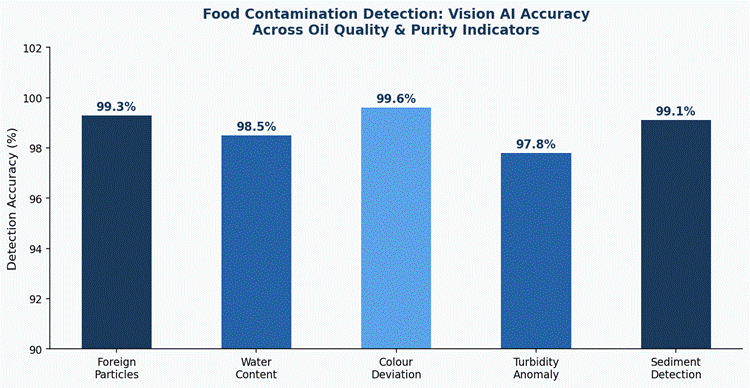
Figure 1: Vision AI detection accuracy across oil quality and purity indicators - 97–99%+ across all contamination categories.
What Makes Oil Purity Inspection Uniquely Challenging
Oil presents optical properties that traditional machine vision systems struggle with. Light transmission, refraction, and the visual signature of contamination all vary with temperature, oil type, container material, and fill level. A particle that's clearly visible in one lighting condition becomes invisible in another.
Foreign particle contamination in oil is particularly difficult - metallic fragments from processing equipment, glass particles from filling line breakages, organic matter from upstream processing, plastic micro-fragments from packaging materials. Each contaminant type has a different optical signature. Each requires different detection logic.
Human inspection at production speed simply cannot consistently detect sub-millimetre particles in a moving, optically complex medium. The limits aren't about inspector skill - they're about human visual physiology.
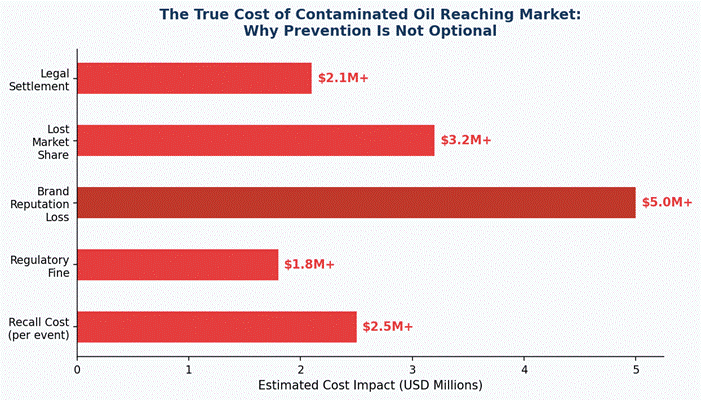
Figure 2: The true cost of contaminated oil reaching market - recall, regulatory, and brand reputation costs that dwarf the investment in prevention.
Vision AI Food Contamination Detection: Five Critical Capabilities
Foreign Particle Detection
AegisVision detects foreign particles down to 0.1mm - including metallic fragments, glass, organic matter, and plastic. The system applies different detection models to different particle types, each calibrated to the specific optical signature of that contaminant in your oil type and container format.
Water Content Anomaly
Water contamination in edible oil manifests as turbidity, micro-droplet formation, or bottom settling - depending on contamination level and temperature. Vision AI detects all three manifestations across the full production run, not just sampled batches.
Colour and Tint Deviation
Colour consistency is a quality indicator and a brand standard. AegisVision verifies colour against defined specifications - catching batch-to-batch variation, processing anomalies, and oxidation indicators that human inspection assesses inconsistently across shifts.
Turbidity and Clarity Analysis
Turbidity - cloudiness caused by suspended particles, water, or oxidation products - is assessed against reference standards for each SKU. The system flags batches that are approaching tolerance limits before they exceed them, enabling process adjustment rather than batch rejection.
Sediment Detection
Bottom sediment in filled containers - which may not be visible immediately after filling but develops within the production window - is detected through time-series visual analysis. Batches at sediment risk are flagged before they reach packaging.
The 2024 American Society for Quality study documented 99.8% surface defect accuracy for AI visual inspection. In oil contamination detection, AegisVision achieves comparable accuracy levels -across all contamination types, at production speed, on every unit produced. |
Protecting Brand Equity Through Preventive Purity Management
Stage 1 — Catch What's Currently Escaping
Immediate deployment on existing filling line cameras. Every bottle or container inspected before it advances to packaging. Contamination incidents that were previously invisible until consumer complaint are now caught at source.
Stage 2 — Trace Contamination to Origin
Pattern analysis identifies contamination clustering around specific equipment, filling stations, time windows, or upstream batches. You're not just catching contaminated products - you're identifying the production conditions that generate contamination. Process correction at source eliminates contamination recurrence.
Stage 3 — Preventive Purity Assurance
Equipment wears indicators that correlate with metallic particle generation are flagged for maintenance before contamination occurs. Upstream processing anomalies that predict downstream contamination trigger early intervention. Your purity assurance system operates preventively - protecting brand equity before any contaminated product is produced.
Vision AI Contamination Detection - Edible Oil | Benchmark |
Foreign particle detection (incl. <0.1mm) | 99.3% |
Water content anomaly detection | 98.5% |
Colour deviation detection accuracy | 99.6% |
Turbidity analysis accuracy | 97.8% |
Sediment detection | 99.1% |
Inspection coverage | 100% of units |
ROI payback period | 6–12 months |
Ready to protect your brand with preventive oil purity monitoring? Visit aegisvision.ai to explore Vision AI contamination detection on your existing filling line infrastructure. |
Conclusion
Maintaining purity in edible oil production is critical for protecting both consumer trust and brand reputation. Manual inspection and batch sampling can miss contamination issues that occur at production speed. Vision AI improves quality control by continuously inspecting every container and detecting particles, turbidity, colour deviations, and other purity risks in real time.
AegisVision enables this by using AI-powered video analytics on existing production line cameras to detect contamination instantly, helping manufacturers protect product quality, prevent recalls, and maintain brand trust.