The Hidden Threat in Your Cooking Oil: How Vision AI Is Revolutionizing Foreign Particle Detection
Foreign particle contamination in cooking oil doesn't announce itself. That's what makes it dangerous.
A metallic fragment from a worn processing pump. A glass particle from a filling line incident cleared hours earlier. An organic contaminant from upstream handling. These particles - invisible to production-line human inspection, undetectable by traditional sampling methods at scale - travel through your quality control system and reach the consumer.
When they do, the consequences scale far beyond the contaminated batch. A single consumer incident with metallic contamination in cooking oil triggers a recall, a regulatory investigation, retailer delisting, and media coverage that permanently alters consumer perception of a brand it took years to build.
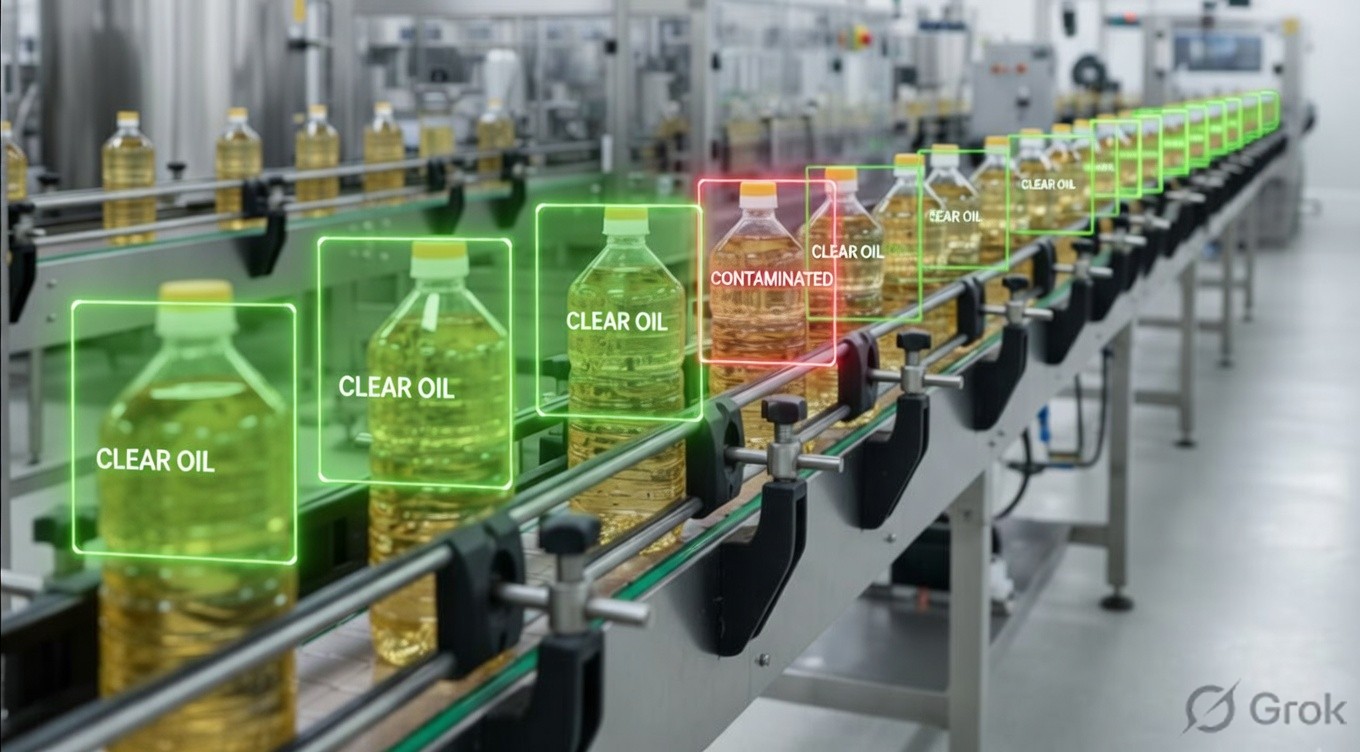
Vision AI foreign particle detection eliminates this risk at source. Not by sampling more aggressively - but by inspecting every unit, at production speed, at resolutions that make particle contamination impossible to miss.
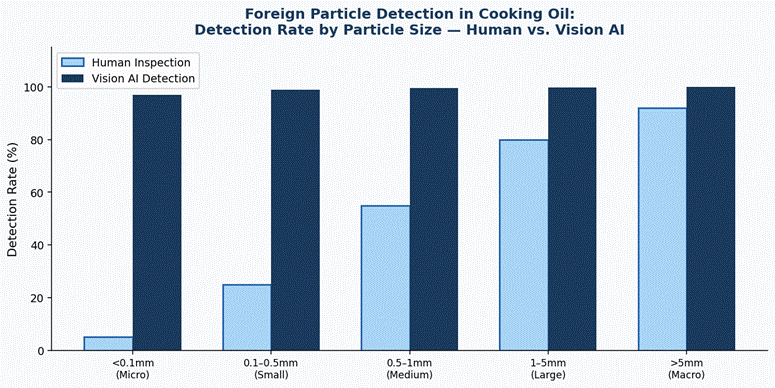
Figure 1: Foreign particle detection rates by particle size - human inspection vs. Vision AI. At microscopic scale, the capability gap is absolute.
Why Foreign Particle Detection in Oil Is a Fundamentally Hard Problem
Oil presents inspection challenges that traditional vision systems weren't designed for. The optical properties of edible oil - light refraction, surface reflectivity, variable viscosity, and the transparency that consumers value as a quality indicator - are precisely the properties that make particle detection difficult.
A metallic fragment suspended in clear oil looks very different from the same fragment on a solid surface. Light refracts around it. The particle's optical signature changes with container curvature, fill level, and ambient temperature. A standard vision system calibrated for one condition misses detections under slightly different conditions.
Human inspection faces an additional challenge: at production speeds of 300–500 containers per minute, the inspection window per unit is milliseconds. For particles under 1mm, reliable human detection at this speed is physiologically impossible - not a training issue, a biology issue.
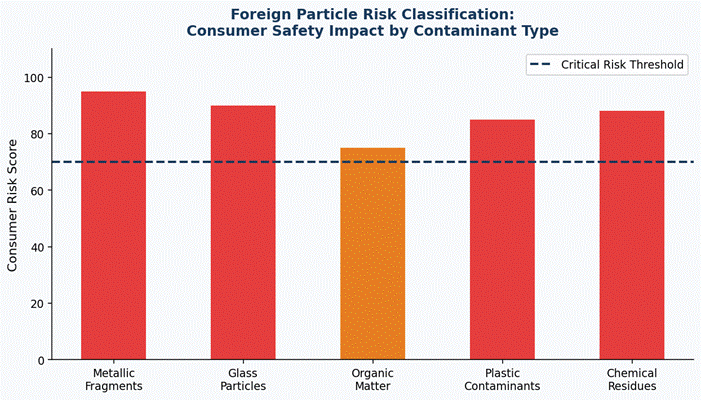
Figure 2: Foreign particle risk classification by contaminant type - metallic and glass particles carry the highest consumer risk scores.
How Vision AI Makes Foreign Particle Detection Viable at Production Scale
Multi-Model Detection Architecture
Different particle types require different detection approaches. AegisVision orchestrates multiple AI models simultaneously - one calibrated for metallic fragments (using reflectivity signatures), one for glass particles (using refraction patterns), one for organic matter (using color and texture analysis). Each model runs on the same camera feed, in the same inspection window, generating composite detection coverage across all particle types.
0.1mm Resolution Detection
AegisVision achieves detection of particles as small as 0.1mm - the same resolution threshold documented in ASQ's 2024 food safety inspection research. This includes the sub-millimeter metallic fragments most commonly associated with equipment wear and the micro-glass particles that filtering systems can miss.
Container-Aware Inspection
Inspection parameters adapt to container type - clear PET, HDPE, glass, different fill levels, different oil viscosities - so detection accuracy is maintained across your full SKU range without manual recalibration between runs.
Filling Line Integration
AegisVision integrates with filling line PLC systems. When particle contamination is detected, the affected container is automatically flagged and routed before it advances to capping and labelling - eliminating the risk of contaminated units entering the packaging stream.
AI catches what human inspection cannot - not because inspectors aren't skilled, but because the physics of production speed and particle size make certain detections physiologically impossible without AI assistance. This is not about replacing inspectors; it's about giving them the capability to protect consumers that biology alone cannot deliver. |
From Detection to Prevention: The Full Particle Control Journey
Stage 1 - 100% Inspection Coverage
Every container inspected. Every particle type monitored. Contamination that was previously invisible - or detectable only through costly offline sampling - becomes visible in real time.
Stage 2 - Source Tracing and Equipment Intelligence
Particle detection patterns trace contamination to source equipment. Metallic particle detections clustering in specific production windows correlate with equipment wear cycles. Glass particle incidents correlate with specific filling stations. You're not just catching contamination - you're eliminating the source.
Stage 3 - Predictive Contamination Prevention
Equipment wears indicators that predict metallic particle generation are flagged for maintenance before contamination begins. Upstream processing anomalies that precede organic contamination events trigger early intervention. Your foreign particle control system operates preventively - protecting consumers before contamination enters the production stream.
Vision AI Foreign Particle Detection - Cooking Oil | Benchmark |
Metallic fragment detection (incl. <0.5mm) | 99.3% |
Glass particle detection accuracy | 98.8% |
Organic matter detection | 97.5% |
Minimum detectable particle size | 0.1mm |
Inspection coverage | 100% of units |
Integration with filling line PLC | Yes — automated routing |
Contamination source tracing | Equipment-level attribution |
ROI payback period | 6–12 months |
Ready to eliminate foreign particle risk from your cooking oil production? Visit aegisvision.ai to see Vision AI contamination detection on your existing filling line cameras. |
Conclusion
Foreign particle contamination in cooking oil is difficult to detect with manual inspection, especially at high production speeds. Vision AI solves this by inspecting every container in real time and identifying metallic, glass, or organic contaminants before they reach consumers.
AegisVision enables this by using AI-powered video analytics on existing production line cameras to detect foreign particles instantly, helping manufacturers prevent contamination, recalls, and brand damage.