From Caps to Labels: How Vision AI Protects Product Quality End-to-End
Think about what it actually costs when a defective product reaches retail. Not just the recall logistics - the brand damage, the regulatory exposure, the customer trust that takes years to rebuild.
A cap that doesn't seal properly. A label applied at 2 degrees of rotation. A date code that printed faintly enough that a consumer might misread it. A fill level 3% below declared volume. None of these are catastrophic on the production floor. All of them become expensive the moment they leave it.
This is the economics of product quality inspection - and it's why Vision AI doesn't just improve quality outcomes. It changes the financial equation of manufacturing.
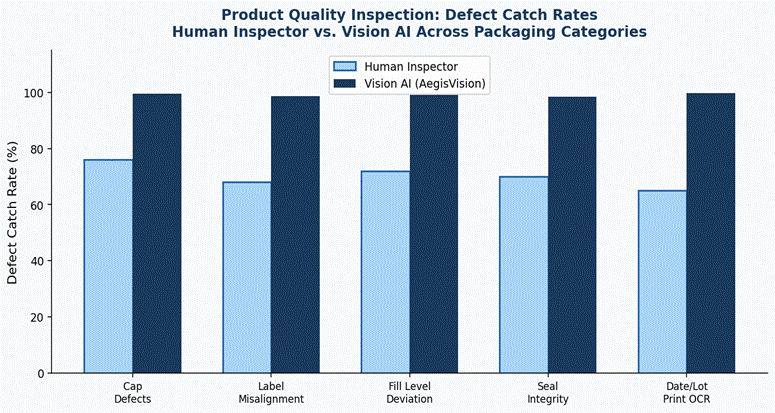
Figure 1: Vision AI vs. human inspector defect catch rates across packaging quality categories-the gap is structural at every category.
What Traditional Quality Control Misses - and Why
Let's face it.. the honest version of most FMCG quality control is sampling plus random checks plus end-of-shift reports. It's not designed to catch everything. It's designed to catch most things and hope the rest don't surface downstream.
Human inspection under optimal conditions achieves roughly 76–82% catch rates on packaging defects. Under real production conditions - line speeds of 300+ units per minute, repetitive visual tasks, shift fatigue - that number drops considerably. Research confirms human accuracy declines measurably over an 8-hour inspection shift regardless of training or experience.
The defects that slip through cluster around specific patterns: small cap torque deviations, subtle label rotation angles, partial date code failures, fill levels near the tolerance boundary. These are precisely the defects that cause the most consumer complaints - visible, identifiable, and completely preventable.
Vision AI Quality Control: The Full Packaging Stack
Cap Integrity and Torque Verification
AegisVision detects cap placement anomalies, missing caps, caps with inadequate torque, and tamper -evident seal failures-at every unit, at production speed. The system differentiates between cosmetic cap defects and structural integrity failures, routing decisions appropriately.
Label Placement and Print Quality
Label rotation, wrinkle defects, adhesion failures, print quality degradation, and label damage are detected with 98.8% accuracy. The system verifies label placement against position tolerances defined by your quality specifications - not by inspector judgment.
Date/Lot Code OCR
Every date code, lot number, and batch identifier is read and verified against production records. Absent codes, faint prints, smeared codes, and incorrect dates are flagged immediately. AI achieves 99.7% OCR accuracy - eliminating the leading cause of product recalls in packaged goods.
Fill Level Verification
Vision AI verifies fill levels against declared volume specifications for every unit. No sampling. No statistical inference. Every bottle, every can, every pouch - checked against your tolerance parameters in real time.
Seal Integrity
Heat seal integrity, induction seal verification, and tamper-evidence checks run continuously. The system detects partial seals, wrinkled seal areas, and seal contamination that create both product integrity and food safety risks.
AI-powered product quality inspection delivers 99%+ catch rates across all packaging defect categories - compared to the 76–82% achieved by human inspection under optimal conditions. At scale, this difference translates directly to fewer customer complaints, fewer regulatory inquiries, and fewer recalls. |
The Journey from Reactive Recalls to Preventive Quality
Stage 1 — Catch What's Currently Escaping
Immediate deployment on existing cameras. Every unit inspected against your specifications from day one. Defect escape rates fall. Customer complaint volumes decline. Your quality team has data-real data-on where problems are actually occurring.
Stage 2 — Identify the Patterns Behind the Defects
After 3–6 months, patterns emerge. Cap defects cluster at specific time windows correlating with equipment calibration drift. Label misalignment spikes occur after material changeovers. Fill level deviations correlate with temperature variations in the filling area. You're no longer chasing individual defects-you're eliminating the conditions that produce them.
Stage 3 — Prevent Rather Than Detect
Automated workflow responses adjust equipment parameters before defect rates exceed thresholds. Maintenance dispatches trigger on predictive signals. Compliance documentation is generated continuously. Your product quality assurance operates preventively-and your brand protection is no longer contingent on human vigilance.
Vision AI Product Quality Inspection — FMCG | Benchmark |
Cap defect detection accuracy | 99.5% |
Label placement verification accuracy | 98.8% |
Date/lot OCR accuracy | 99.7% |
Fill level verification (every unit) | 100% coverage |
Seal integrity detection | 98.5% |
Human inspection catch rate (optimal conditions) | 76–82% |
ROI payback period | 6–12 months |
Retail Vision AI ROI over 5 years (Gartner/IHL 2024) | 180–400% |
Ready to catch every cap defect, label error, and date code failure before it reaches retail? Visit aegisvision.ai to see Vision AI quality inspection on your existing production line. |
Conclusion
Packaging defects such as loose caps, misaligned labels, incorrect fill levels, and unreadable date codes can easily escape manual inspection, especially at high production speeds. Vision AI improves quality control by inspecting every unit in real time and identifying defects before products leave the production line.
AegisVision enables this by using AI-powered video analytics on existing production line cameras to detect packaging defects instantly, helping manufacturers prevent recalls, reduce customer complaints, and protect brand reputation.