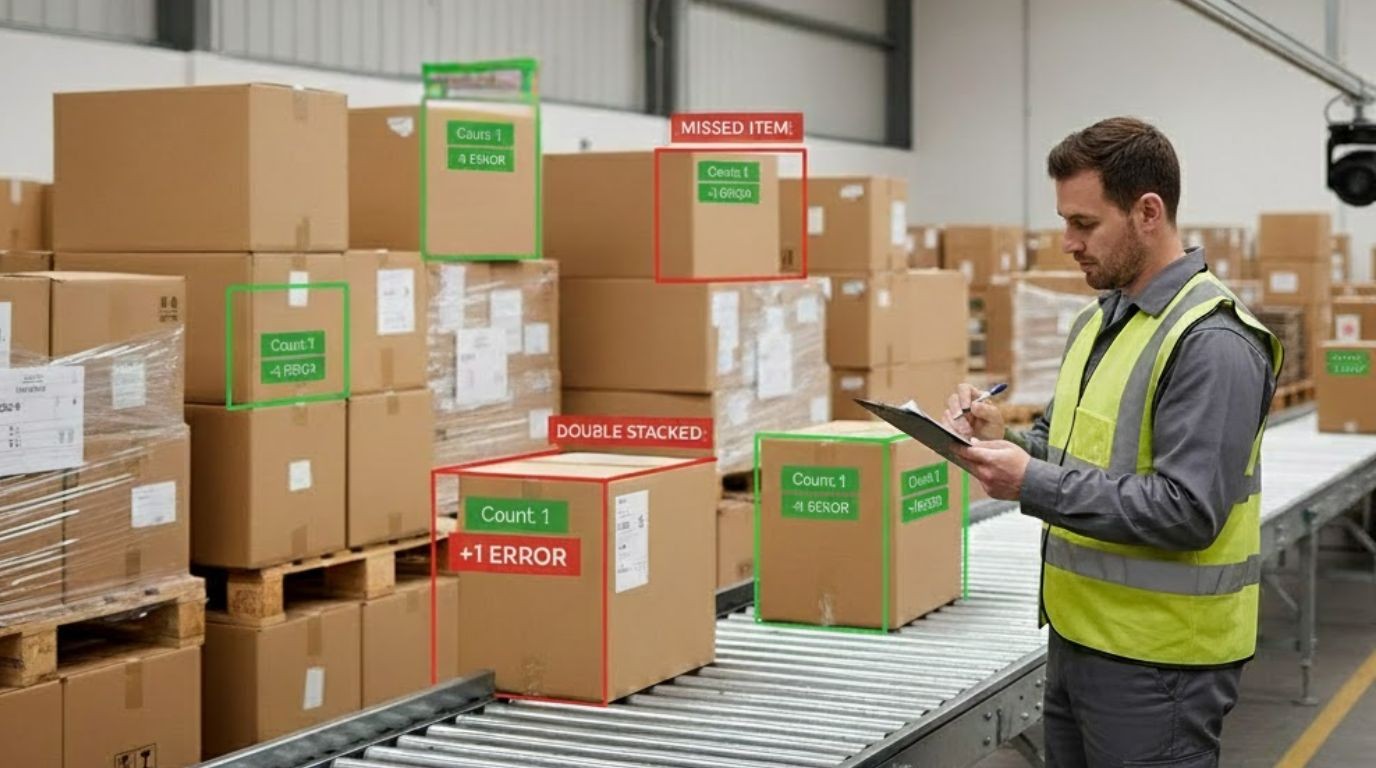
On a humid Tuesday in July, a Tier 1 automotive supplier watched a routine outbound load leave their dock. The digital records were pristine: 2,400 precision assemblies across 60 pallets, verified three times by handheld scanners. Yet, 48 hours later, the OEM customer flagged a 2% short shipment and a labeling mismatch on two pallets.
The fallout was immediate and expensive. The supplier faced expedited replacement costs, overtime labor for a "root cause" war room, and a damaged On-Time In-Full (OTIF) score. However, the true cost was reputational. An avoidable error had been amplified by a global customer during a quarterly vendor review.
This scenario is not unique. In the postmortem, leadership discovered a chain of minor failures: scuffed barcode labels that manual scanners missed, mixed SKUs packed under pressure, and cycle counts that matched the Warehouse Management System (WMS) but failed to reflect physical reality.
The solution wasn't more manual checks. The turning point came when the team deployed Product Counting Vision AI at critical choke points—receiving, kitting, and dispatch. By closing the gap between digital records and physical truth, the facility improved counting speed by 10–15× and drove accuracy above 99%.
The Hidden Cost of Manual Counting: A Real-World Case Study
Manual counting is the silent killer of supply chain efficiency. In the automotive case study above, the reliance on human verification and handheld scanners created a false sense of security. Workers under compressed schedules often scan a single label and assume the rest of the pallet matches, or they bypass damaged labels entirely to keep the line moving.
The hidden costs of these errors extend far beyond the immediate chargebacks. They include:
Operational Drag: Teams are pulled from value-added tasks to investigate discrepancies.
Inventory Bloat: Safety stock is artificially inflated to compensate for lack of trust in inventory data.
Customer Friction: repeated errors erode trust, leading to stricter penalties and potential contract losses.
When the supplier switched to automated visual inspection, the system flagged mis-SKUs before shrink-wrapping occurred. It reconciled pallet counts against Advance Shipping Notices (ASNs) in real time and attached visual evidence to every exception. The result was a system that measured what actually moved, not just what the WMS said should have moved.
Why Vision AI Accuracy Matters: From 65% to 99%
Accuracy is a brand promise. Industry data reveals that manual or barcode-only verification typically hovers around 65–75% accuracy. This drops even lower during peak loads or when dealing with damaged labels and mixed pallets. Humans fatigue; cameras do not.
Vision AI bridges this gap by fusing real-time object detection with vision-based barcode detection software and Optical Character Recognition (OCR). This technology reads labels, detects misplacements, and verifies labeling accuracy before a shipment ever leaves the dock. Leading deployments consistently report 97–99%+ counting accuracy, dramatically cutting shrinkage and audit rework.
The shift is significant enough that Gartner predicts a major industry transformation: by 2027, 50% of companies with warehouse operations will utilize AI-enabled vision systems to replace legacy scanning-based cycle counting.
The Technology Behind 99%+ Accuracy
The math behind this accuracy is robust. Modern detectors, such as YOLOv8, are evaluated using metrics like IoU (Intersection over Union) and mAP (mean Average Precision). However, raw detection isn't enough.
Advanced systems use temporal tracking to validate movement and continuity, reducing false positives. In practice, hybrid models that combine detection, tracking, and OCR reduce counting errors by over 60% compared to manual audits. Crucially, these systems maintain <50 ms inference per stream at edge locations, ensuring that high-speed accuracy never becomes a bottleneck for production throughput.
Speed as Operational Leverage: Always-On Auditing
Speed is where Vision AI transforms from a safety net into operational leverage. Traditional auditing requires stopping the line or pausing operations to conduct cycle counts. Vision AI turns every camera into an always-on auditor.
With high-resolution cameras positioned at receiving docks, conveyor intersections, and dock doors, Product Counting using Machine Vision Platforms continuously counts units, cartons, totes, or pallets. This happens inline, meaning the production flow never stops. Discrepancy alerts are surfaced to supervisors in seconds, allowing for immediate correction rather than retroactive investigation.
To achieve this, facilities utilize edge deployments (using hardware like Jetson, NUC, or TPU) to minimize cloud costs and latency. These camera-agnostic platforms can often integrate with existing CCTV networks, deploying AI-powered barcode scanning solutions to validate label integrity. The operational impact is tangible:
Receiving: Auto-counts against ASNs/POs.
Put-away: Confirmation to prevent miss-lots.
Gate Control: Reconciliation of exit counts against delivery notes.
Operational Efficiency: Shifting from Manual to Exception-Driven Work
Vision AI fundamentally flips the audit paradigm. Instead of teams walking aisles with clipboards hoping to find errors, the system automatically detects exceptions—such as mis-SKUs, under/overcounts, or mislabeled pallets—and directs human intervention only where it is needed.
This shift from manual searching to exception handling delivers 30% faster throughput and 50% fewer losses in mature implementations. Automated reconciliation against ERP, WMS, or TMS systems further streamlines the process, providing image and video snippets as irrefutable evidence of the physical state of goods.
Furthermore, these platforms extend beyond simple counting. They serve as a labeling accuracy detection system, identifying defects and verifying quality in real time. This reduces downstream returns and chargebacks, ensuring that the inventory in the system matches the inventory available for sale.
Customer Delight and Brand Protection: The Strategic Dividend
Ultimately, customers do not care about your internal processes; they care about availability and reliability. When Vision AI ensures that the right products arrive in the right quantities with the correct labels, two strategic outcomes follow: fewer delivery disputes and consistent OTIF scores.
This consistency drives customer delight. It reduces penalty freight costs and urgent rework, protecting the brand during critical vendor scorecard reviews. In retail and FMCG sectors, sustained on-shelf accuracy correlates with a 10–15% sales lift and measurable shrink reduction.
The reputational benefit is your insurance policy. As supply chains move toward continuous auditing and digital twins, Vision AI acts as the lens that captures physical truth. In environments where a single miscount can ripple through dispatch, billing, and customer satisfaction, having a traceable evidence trail is essential for dispute resolution and brand integrity.
Implementation Roadmap: Five Steps to Deployment Without Disruption
Implementing Vision AI does not require a complete overhaul of your facility. Leaders succeed by following a phased approach:
Start Small, Instrument Key Zones: Begin with high-impact areas like receiving, kitting, or dispatch. This proves the value of accuracy and exception handling early, aligning with Gartner’s recommendation to start with cycle counting.
Use Hybrid Edge–Cloud Architecture: Keep inference processing close to the floor (Edge) for speed, while centralizing analytics and dashboards in the cloud for leadership visibility.
Integrate Early with ERP/WMS: Ensure counts are reconciled automatically. Alerts should carry visual context to cut the manual triage loop significantly.
Expand to Quality and Labeling Verification: Once counting is stable, leverage OCR and barcode reading to eliminate label-related discrepancies before they travel downstream.
Measure What Matters: Track metrics like accuracy (mAP/PQ), latency, discrepancy resolution time, and OTIF recovery to tie Vision AI outcomes directly to executive KPIs.
The Future of Supply Chain Visibility: Continuous Auditing and Digital Twins
The story of the automotive supplier is familiar because the root causes—pressure, manual error, and fragmented systems—are universal. Vision AI for Product Counting changes the equation by bringing accuracy, speed, and operational efficiency that directly convert into sustained brand reputation.
As industries move toward fully digitized supply chains, the ability to reconcile physical truth with digital records will define market leaders. AegisVision helps manufacturers, 3PLs, and retailers implement Product Counting Vision AI, vision-based barcode detection software, and labeling accuracy detection systems without disrupting the line. By turning cameras into always-on auditors, you can elevate your OTIF scores and secure your brand's promise.
Frequently Asked Questions
What problem does Vision AI solve in warehouses?
Vision AI prevents costly counting errors by automatically detecting misplacements, damaged labels, and inventory discrepancies in real time. It replaces manual scanning with always-on visual verification, improving accuracy from 65–75% to 99%+ and catching errors before shipment.
How much faster is Vision AI compared to manual counting?
Vision AI improves counting speed by 10–15× while eliminating the need to stop production lines. It continuously audits inline, surfacing discrepancy alerts to supervisors in seconds rather than requiring retroactive investigation.
What technology enables 99%+ accuracy?
Advanced systems combine real-time object detection (YOLOv8), temporal tracking, and OCR to read labels and verify accuracy. Hybrid models reduce counting errors by over 60% compared to manual audits while maintaining sub-50ms inference speeds.
How does Vision AI reduce operational costs?
It shifts teams from manual searching to exception-driven work only, delivering 30% faster throughput and 50% fewer losses. Automated reconciliation against WMS/ERP systems eliminates chargebacks and safety stock bloat caused by inventory distrust.
Can Vision AI integrate with existing warehouse systems?
Yes, camera-agnostic platforms integrate with existing CCTV networks and connect to ERP, WMS, or TMS systems. Edge deployments on hardware like Jetson minimize latency and cloud costs while supporting phased rollout across receiving, kitting, and dispatch zones.