Automating Health Compliance in Tea Manufacturing: No Human Surveillance Required
Tea manufacturing has a quality problem that no amount of inspector training fully solves: consistency across shifts.
A master grader on the day shift has decades of experience identifying leaf quality, colour consistency, and foreign matter with remarkable accuracy. The night shift inspector-newer, more fatigued, working in different lighting conditions-produces different results on the same batches. The product that reaches export markets reflects whichever inspector happened to be working that day.
This isn't a people problem. It's a structural problem with human inspection. And it has a structural solution: vision systems for quality inspection that operate identically - with 99%+ accuracy-regardless of shift, time, or inspector availability.
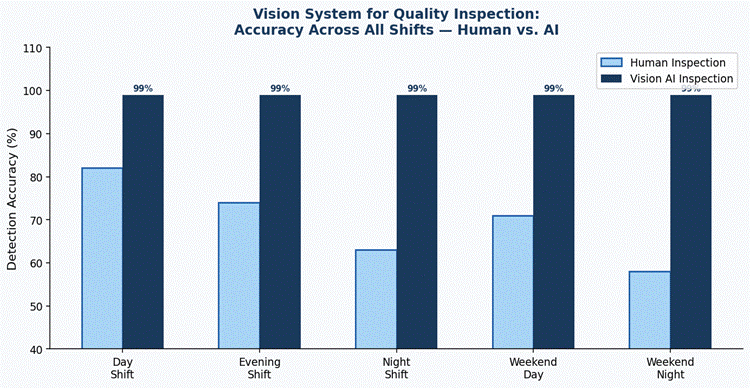
Figure 1: Inspection accuracy across all shifts-human vs. Vision AI. AI maintains 99% accuracy while human accuracy varies significantly by shift and fatigue.
The Specific Quality Challenges in Tea Manufacturing
Tea processing sits at the intersection of agricultural variability and precision manufacturing. The quality challenges are real and costly:
Grade Consistency
Tea grading is highly subjective when left to human inspection. Colour, leaf size, twist consistency, and moisture appearance all vary subtly-and human graders, even experienced ones, assess these differently across shifts and individuals. Export grade rejections and buyer quality disputes trace directly to this inconsistency.
Foreign Matter Detection
Stems, fibres, insects, pesticide residue indicators, and non-tea plant material all represent contamination risks that carry food safety implications. Traditional inspection misses foreign matter that's small, camouflaged against leaf colour, or present in volumes that create inspection fatigue.
Crop Health Upstream
Quality in the cup starts at the estate. Leaf health, pest damage, moisture stress, and disease indicators that aren't caught upstream create quality problems that downstream processing cannot fix. Crop health monitoring through Vision AI-from drone feeds or ground-level cameras-gives estate managers early intervention signals that protect both yield and downstream quality.
Packaging and Date/Lot Compliance
Mislabelled batches, incorrect date coding, seal integrity failures, and weight deviations all carry compliance and recall risk. Manual end-of-line checks catch some-not all-and create bottlenecks when inspection pace can't match production speed.
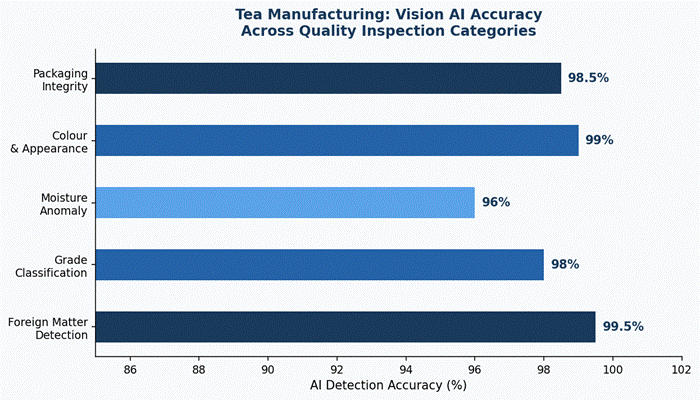
Figure 2: Vision AI detection accuracy across tea manufacturing quality inspection categories-consistency that human inspection cannot match at scale.
How Vision AI Solves Tea Manufacturing Quality Problems
100% Inspection Coverage, Every Batch
AegisVision connects to existing cameras on processing lines. Every batch is inspected-not sampled. The system applies trained models calibrated to your specific tea grades, leaf types, and quality thresholds. Grading consistency is achieved not through better training of human inspectors, but by removing human variability from the grading decision entirely.
Foreign Matter Detection at Microscopic Scale
Vision AI detects foreign matter at 0.1mm resolution-catching contaminants that human inspection simply cannot identify at production speeds. Detection is immediate, and workflow responses-flagging, routing, quarantine-are automated. No contaminated batch advances without human review of the AI-generated evidence pack.
Estate-Level Crop Health Monitoring
Drone feeds from tea estates can be processed through AegisVision's platform to detect early indicators of pest damage, disease spread, moisture stress, and nutrient deficiency. Estate managers receive GPS-tagged alerts with visual evidence-enabling targeted intervention before quality degradation compounds across entire sections of the estate.
Automated Compliance Verification
Date/lot print OCR, seal integrity verification, weight deviation detection, and label accuracy checks run simultaneously with quality inspection-at production speed. Compliance documentation is generated automatically, creating audit-ready records without manual data entry.
The vision system for quality inspection doesn't replace your quality team-it gives them real-time intelligence to act on, rather than defect reports to investigate after the damage is done. |
The Three-Stage Journey for Tea Manufacturing
Stage 1 — Consistent Inspection Across All Shifts
Immediately after deployment, grading consistency standardises across shifts. Night shift results match day shift results. Export grade rejections fall as the inspection standard becomes uniform and objective. Your quality team stops investigating inconsistency and starts improving the process.
Stage 2 — Pattern-Based Quality Prediction
The system begins correlating quality outcomes with upstream variables-estate sections, processing batches, seasonal conditions, equipment state. Quality trends become predictable. You see quality problems forming before they reach the inspection point.
Stage 3 — Preventive Quality Assurance
Automated responses adjust processing parameters when drift is detected. Batch quarantine decisions trigger without manual review. Crop health alerts from the estate propagate to processing floor decisions. Your quality assurance system operates preventively-not reactively.
Vision AI Quality Inspection — Tea Manufacturing | Benchmark |
Grade consistency accuracy | 99%+ |
Foreign matter detection (incl. <0.5mm) | 99.3% |
Inspection coverage vs. sampling | 100% vs. spot-check |
Shift consistency variance (AI vs. human) | Zero vs. 20–30% |
Compliance document generation | Automated, audit-ready |
ROI payback period | 6–12 months |
Ready to eliminate shift inconsistency and foreign matter risk from your tea processing operations? Visit aegisvision.ai for a walkthrough on your existing camera infrastructure. |
Conclusion
Maintaining consistent quality in tea manufacturing is challenging when inspection relies on manual processes that vary across shifts and conditions. Vision AI improves quality assurance by enabling continuous inspection, consistent grading, and early detection of contamination or compliance issues across every batch.
AegisVision enables this by using AI-powered video analytics on existing processing and packaging line cameras to automate quality inspection, helping tea manufacturers improve consistency, ensure compliance, and protect product quality.