Auditable AI Pipelines: Turning Vision Models into Business Evidence for Telecom Companies
Here's the tension every telecom operations leader knows intimately: you can have the best predictive maintenance system in the industry, but if you can't prove what it detected, when it detected it, and what action was taken it didn't happen.
In telecom, this isn't a bureaucratic concern. SLA disputes, regulatory audits, insurance claims, contractor accountability-all of them come down to evidence. Timestamped, GPS-tagged, chain-of-custody evidence that a human-managed inspection regime simply cannot generate at scale.
This is why the most sophisticated telecom operators aren't just deploying computer vision predictive maintenance. They're deploying auditable AI pipelines-systems where every detection generates structured business evidence, not just an alert.
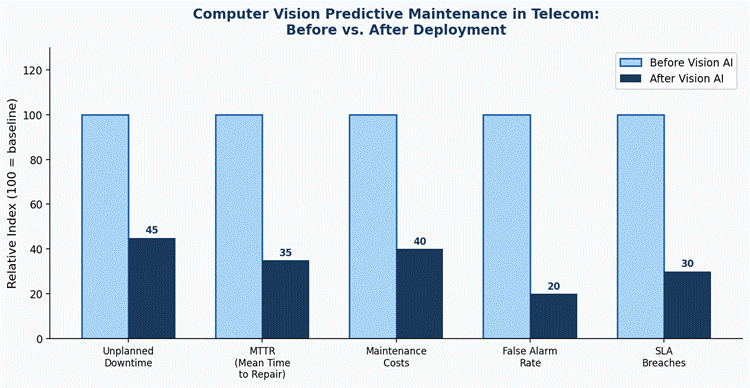
Figure 1: Computer Vision Predictive Maintenance-key operational metrics before and after deployment.
The Real Cost of Reactive Telecom Infrastructure Maintenance
The numbers on telecom downtime are unambiguous. A Siemens report calculated that unplanned downtime wiped out 11% of annual turnover for Fortune Global 500 companies - a figure projected to surpass $2.5 trillion by 2025. For individual telecoms, each major outage carries SLA penalty exposure, customer churn risk, and regulatory scrutiny that compounds the direct operational cost.
Traditional maintenance approaches-scheduled inspections, reactive dispatch, manual visual checks -have three structural weaknesses that predictive AI eliminates:
• Inspection gaps - scheduled visits create windows where degradation accelerates unobserved. Tower corrosion, cable strain, cabinet seal failures develop between visits
• Detection inconsistency - human inspection quality varies with technician experience, environmental conditions, and time pressure. The same degradation looks different to different eyes
• Evidence fragility - manual inspection reports are subjective, inconsistently formatted, and routinely challenged in SLA disputes and insurance claims
Up to 80% of near-miss events go unrecorded in manual inspection systems. In telecom, this creates a hidden risk profile that only becomes visible when it causes a service interruption - and the dispute that follows. |
What Auditable Computer Vision Predictive Maintenance Delivers
24/7 Visual Monitoring of Critical Infrastructure
AegisVision connects to existing camera feeds across tower sites, equipment cabinets, fiber routes, and data centre infrastructure. The platform monitors continuously detecting corrosion, mechanical stress, cable anomalies, cooling system degradation, and access violations in real time.
Unlike scheduled inspections, continuous vision monitoring catches degradation at the earliest visible stage-when intervention cost is lowest and before service impact occurs.
Predictive Pattern Recognition Across Sites
Cross-site pattern learning is where computer vision predictive maintenance earns its name. Tower components on Site A showing early corrosion patterns that preceded failure at Site B get flagged immediately. Environmental conditions-temperature cycling, humidity exposure, vibration frequency-that correlate with failure modes at one location inform monitoring priorities at similar sites across the network.
This isn't reactive maintenance with AI-generated alerts. It's genuine prediction-surfacing failure risk before the failure occurs.
Audit-Ready Evidence Generation
Every detection in AegisVision generates a structured evidence pack: timestamp, GPS coordinates, asset ID, camera feed snapshot, AI confidence score, defect classification, and assigned workflow status. This evidence is GDPR-compliant, exportable, and formatted for regulatory submissions, SLA dispute resolution, and contractor accountability.
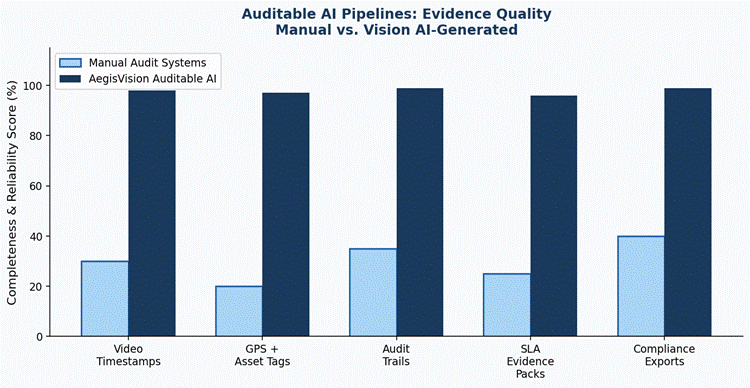
Figure 2: Auditable AI evidence quality - manual audit systems vs. AegisVision AI-generated evidence packs across five evidence dimensions.
The Evidence Pipeline: From Detection to Business Record
Think about what a traditional SLA dispute looks like. A service interruption occurs. The telecom operator claims the fault was in the contractor's-maintained equipment. The contractor disputes it. Both sides produce inspection reports-handwritten, inconsistently formatted, with differing accounts of what was observed and when.
Now think about what the same dispute looks like with an auditable AI pipeline. AegisVision's evidence pack shows: the specific component, the visual state at 47 prior inspection timestamps, the degradation trajectory, the alert generated 23 days before the failure, the workflow assignment, and the contractor's acknowledgment record. The dispute resolves in days, not months.
This is why we say AegisVision transforms Vision AI from a monitoring tool into a business intelligence system. The evidence it generates has value beyond operations - it has legal, commercial, and regulatory value.
AegisVision — Telecom Predictive Maintenance Outcomes | Benchmark |
Unplanned downtime reduction | 45–65% |
Mean time to repair (MTTR) improvement | 35–50% |
Maintenance cost reduction | 30–45% |
False alarm rate reduction vs. rule-based systems | 70–80% |
SLA dispute resolution time (with evidence packs) | Days vs. months |
Evidence completeness vs. manual inspection | 99% vs. 40% |
ROI payback period | 6–12 months |
The Three-Stage Transformation for Telecom Operations
Stage 1 — Reactive to Monitored
Cameras connect to existing infrastructure. Baseline visual profiles are established for every monitored component. The system begins detecting anomalies that scheduled inspections were missing. Your maintenance team stops being surprised by failures.
Stage 2 — Monitored to Predicted
Degradation patterns become visible across sites and component types. Maintenance dispatches are prioritized by risk score rather than schedule. Your field teams work smarter-going where the risk is highest, when it matters, with AI-generated evidence of what they'll find.
Stage 3 — Predicted to Prevented
Automated workflow responses trigger maintenance dispatches before failure risk reaches critical threshold. SLA compliance is enforced by the system. Regulatory audit packs are generated automatically. Your operations team shifts from firefighting to optimization.
AegisVision integrates with your existing ticketing, asset management, and ERP systems-so the AI-generated evidence flows into your existing business processes without requiring new platforms or workflows. |
Frequently Asked Questions
How does Vision AI integrate with telecom field operations?
AegisVision integrates with existing ticketing and asset management systems through standard APIs. Detections generate structured work orders with evidence packs attached - so field teams arrive with AI-curated context, not just a dispatch ticket.
What infrastructure can Vision AI monitor?
Tower components, equipment cabinets, cable routes, fiber deployment verification, substation surveillance, access control and restricted zone monitoring, and drone-captured site surveys. The platform processes multiple input types - live feeds, drone archives, and document-based evidence simultaneously.
Ready to turn your infrastructure monitoring into an auditable evidence pipeline? Visit aegisvision.ai to schedule a demonstration. |
Conclusion
Telecom infrastructure requires continuous monitoring and reliable evidence to prevent downtime, resolve disputes, and maintain regulatory compliance. Manual inspections and reactive maintenance often leave gaps that lead to unexpected failures and operational risks. Vision AI improves telecom operations by enabling real-time monitoring, predictive maintenance, and structured evidence generation across critical infrastructure.
AegisVision enables this by using AI-powered video analytics on existing telecom infrastructure cameras to detect anomalies early, generate audit-ready evidence, and help telecom operators maintain reliable and efficient network operations.