The Economics of Safer Roads: Why Vision AI Is a Smart Investment for Urban Mobility
Road safety has an economics problem that most city administrators know but rarely state directly: the cost of preventing a road fatality is an order of magnitude lower than the cost of the fatality itself.
The World Health Organization estimates the economic cost of road traffic injuries and fatalities at 3% of GDP in most countries. For a mid-size city, that number translates to hundreds of millions in lost productivity, emergency response costs, healthcare burden, and economic impact on affected families.
Traditional traffic enforcement - physical officers, periodic camera reviews, reactive response to incidents - captures a small fraction of violations and has essentially no predictive capability. The same high-risk intersections, the same dangerous behaviours, the same violation patterns recur because the enforcement system doesn't learn.
Vision AI traffic violation detection systems change this equation fundamentally. They don't just catch more violations. They generate the evidence, the patterns, and the network intelligence to make urban mobility structurally safer over time.
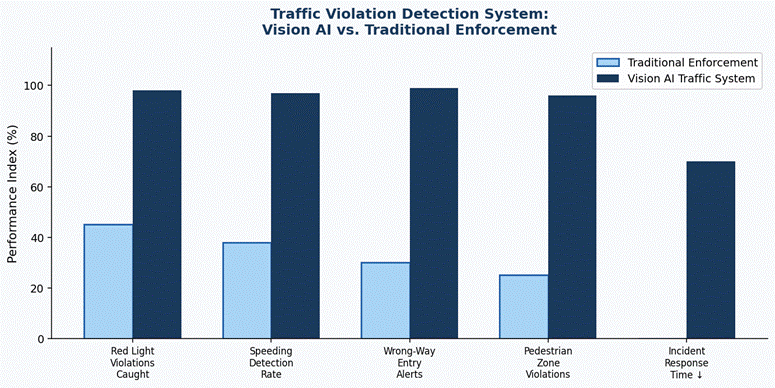
Figure 1: Traffic violation detection - Vision AI vs. traditional enforcement across key violation categories.
What Vision AI Traffic Violation Detection Actually Detects
Red Light and Signal Violation Detection
AegisVision detects red light violations in real time - generating timestamped video evidence with vehicle identification, speed at point of crossing, and signal state confirmation. Detection rate: 98%+. Evidence quality: prosecution ready.
Speeding and Vehicle Classification
Speed monitoring through Vision AI doesn't require dedicated speed cameras. The platform extracts speed data from existing traffic camera feeds, classifying violations by vehicle type, speed differential, and road condition - enabling tiered enforcement responses.
Wrong-Way Entry and Contra-Flow Violations
Wrong-way entry into one-way streets, contra-flow violations on divided roads, and unauthorised entry into restricted zones are detected within seconds of occurrence - generating real-time alerts to traffic control centres for immediate response.
Pedestrian Zone and School Zone Monitoring
Time-restricted pedestrian zones, school zone speed compliance, and pedestrian crossing violations are monitored continuously. Real-time alerts enable immediate enforcement response during high-risk periods.
ANPR and Vehicle Identification
Automatic Number Plate Recognition across all monitored approaches - enabling stolen vehicle detection, permit verification, and enforcement linkage to the existing traffic management system.
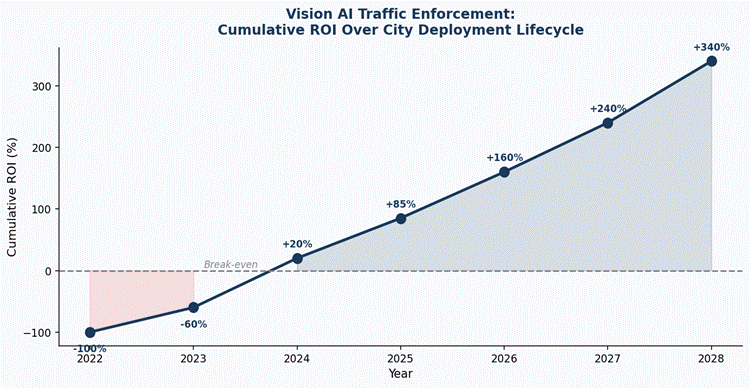
Figure 2: Cumulative ROI trajectory for Vision AI traffic enforcement - break-even within Year 1, compounding returns through Year 3 and beyond.
The Real-Time Alert Architecture That Changes Urban Safety
Real-time alerts are only as valuable as the response capability behind them. AegisVision's alert architecture is designed for operational integration - not just notification.
Every violation detection generates a structured alert with: GPS coordinates, timestamp, vehicle classification, violation type, video evidence clip, and confidence score. This alert flows directly into the traffic management system, enforcement dispatch, or automated penalty system - depending on the configuration.
The shift from reactive enforcement to real-time alert-driven response compresses incident response times from minutes to seconds. In high-risk scenarios - wrong-way drivers, pedestrian zone intrusions - this time compression is the difference between a near-miss and a fatality. |
The Three-Stage Journey to Safer Urban Mobility
Stage 1 — Comprehensive Detection Coverage
Existing traffic cameras across the city network connect to AegisVision. Violation detection begins immediately across all monitored approaches. Coverage gaps that traditional enforcement creates are eliminated - the system monitors every feed, every intersection, every restricted zone, simultaneously.
Stage 2 — Network Pattern Intelligence
Cross-intersection patterns emerge. High-risk time windows at specific locations become visible. Violation behaviour patterns - repeat offenders, vehicle types, weather correlation, event-driven spikes - inform enforcement prioritisation. The city's traffic management strategy becomes evidence-based, not assumption-based.
Stage 3 — Preventive Safety Infrastructure
Enforcement resources are deployed where data shows they have maximum impact. Signal timing adjustments reduce violation rates at specific intersections. Predictive risk alerts enable preventive deployment before incidents occur. Urban mobility safety improves structurally - not through more enforcement, but through smarter enforcement informed by continuous AI intelligence.
Vision AI Traffic Detection System — Urban Mobility | Benchmark |
Red light violation detection rate | 98%+ |
Speeding detection accuracy | 97% |
Wrong-way entry alert latency | <10 seconds |
Evidence package quality (prosecution-ready) | 99% |
Coverage vs. traditional enforcement | 24/7 vs. patrol schedule |
Cross-network pattern learning | Real-time, continuous |
ROI payback (city deployments) | Year 1–2 |
Ready to make your urban traffic enforcement smarter and your roads structurally safer? Visit aegisvision.ai to explore Vision AI traffic monitoring on your existing camera infrastructure. |
Conclusion
Road safety challenges cannot be solved by periodic enforcement alone, especially in growing urban environments with increasing traffic volumes. Vision AI improves road safety by enabling continuous monitoring, real-time violation detection, and data-driven traffic management that helps cities respond faster and prevent incidents.
AegisVision enables this by using AI-powered video analytics on existing traffic cameras to detect violations, generate actionable insights, and help cities build safer and smarter urban mobility systems.