High-Speed Camera Spectacle Inspection: Why Vision AI Is the Only Answer at Scale
There's a specific moment in optical manufacturing where human inspection stops being viable - and most manufacturers know exactly when they hit it.
At 500 lenses per hour, a skilled inspector can maintain meaningful accuracy. At 2,000 per hour, performance drops. At 5,000 per hour - which modern precision optics production lines routinely achieve -human inspection becomes a formality. You're checking, but you're not really catching.
Spectacle lenses and precision optical components have zero tolerance for this gap. A scratch on a lens that reaches a customer. A coating defect that causes visual distortion. A surface imperfection invisible to an overworked inspector that results in a return, a complaint, and a customer who won't buy from that brand again.
Vision AI doesn't slow down at 5,000 units per hour. It doesn't blink. And it doesn't compromise on 0.1mm surface defect detection because it's 4 hours into a shift.
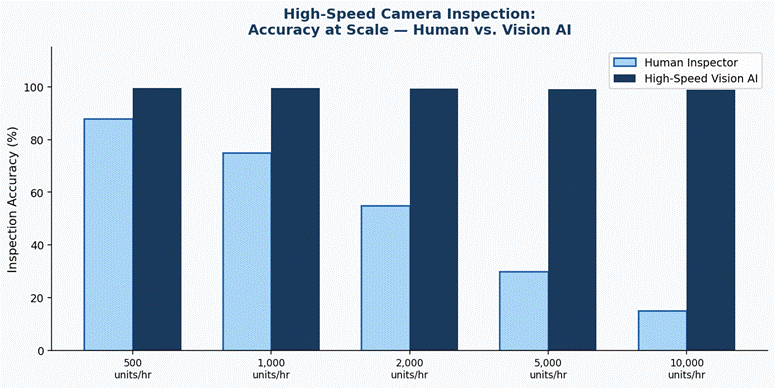
Figure 1: Inspection accuracy at scale - as production speed increases, human accuracy collapses while Vision AI maintains 99%+ across all throughput levels.
Why Optical Component Inspection Is a Uniquely Hard Problem
Spectacle lens inspection isn't just a speed problem - it's a precision problem. The defects that matter to consumers are often the hardest to detect:
• Subsurface scratches that appear under certain lighting angles only
• Coating adhesion failures that show as micro-blistering
• Refractive index anomalies visible only under polarised light
• Edge chipping that affects frame fit without obvious visual impact
• Tinting consistency deviations across lens batches
Human inspection under ideal conditions catches 70–75% of these defects. In high-speed production environments, that number drops below 50%. The defects that escape are not random - they tend to be the subtle, high-impact ones that cause the highest rate of customer returns and warranty claims.
What High-Speed Vision AI Inspection Delivers for Optical Manufacturing
Sub-10ms Inspection at Full Production Speed
AegisVision's sub-10ms inference speed means inspection happens within the camera's field of view at line speed - no production slowdown, no inspection bottleneck. The system processes every unit independently, in parallel streams where multiple camera angles cover different defect types simultaneously.
Multi-Light-Condition Defect Detection
Different defect types reveal themselves under different lighting conditions. AegisVision orchestrates multiple vision models - standard illumination for surface scratches, polarised light analysis for coating anomalies, backlit inspection for internal inclusions - across simultaneous streams. One platform, multiple inspection modalities.
Coating and Tinting Verification
Anti-reflective coating uniformity, tinting consistency, and UV treatment verification are assessed against reference specifications - not against inspector memory or experience. Every lens is compared against the defined quality standard, not the inspector's interpretation of it.
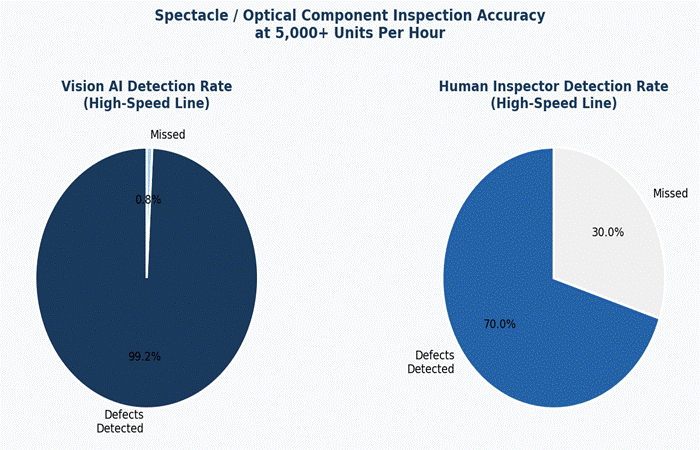
Figure 2: Detection rate comparison at high production speeds - Vision AI vs. human inspection. At 5,000+ units per hour, the gap is categorical.
The Economics of High-Speed Optical Inspection
The business case for Vision AI in optical manufacturing comes down to a simple calculation: what does one defective lens reaching a customer actually cost?
Direct costs are visible - replacement, shipping, warranty processing. But the indirect costs are larger. A customer who receives a defective spectacle lens has a high probability of switching to a competitor brand. That customer's lifetime value - potentially decades of optical purchases is lost.
In optical retail, where brand loyalty drives repurchase and recommendation behaviour, quality escapes don't just cost the value of the returned product. They cost the relationship.
AI catches 37% more defects than human inspectors in controlled studies. In high-speed optical inspection environments, where human accuracy collapses at scale, the true differential is significantly larger. |
High-Speed Vision AI Inspection — Optical Manufacturing | Benchmark |
Surface defect detection accuracy (0.1mm resolution) | 99.2% |
Inspection throughput (units per hour) | Up to 10,000+ |
Coating uniformity verification | 98.8% accuracy |
Multi-stream simultaneous inspection | Yes (edge/surface/coating) |
Defect catch rate vs. human (high-speed lines) | +29% advantage |
False positive rate (waste reduction) | Very low (calibrated) |
ROI payback period | 6–12 months |
Deployment on Existing Optical Inspection Infrastructure
AegisVision connects to existing camera systems on optical inspection lines. Existing polarised light rigs, backlit inspection stations, and surface illumination systems are integrated without hardware replacement.
Pre-built models for optical defect detection are included and can be fine-tuned to your specific lens types, coating systems, and quality tolerance parameters. Custom model development for specialist inspection requirements-specific coatings, proprietary lens designs-is supported through AegisVision's model-agnostic architecture.
Ready to maintain 99%+ inspection accuracy at your full production throughput? Visit aegisvision.ai to see high-speed Vision AI optical inspection in action. |
Conclusion
In high-speed optical manufacturing, maintaining consistent inspection accuracy is extremely difficult with manual inspection alone. As production speeds increase, subtle defects such as scratches, coating issues, or surface imperfections can easily go unnoticed. Vision AI addresses this challenge by enabling fast, precise inspection of every lens without slowing down production.
AegisVision enables this by using AI-powered video analytics to inspect spectacle lenses in real time, helping optical manufacturers maintain high quality standards, reduce defects, and protect brand reputation.