Visual inspection has long been a cornerstone of quality control in manufacturing. From identifying surface imperfections to verifying assemblies, human inspectors have traditionally played a central role in ensuring products meet required standards. However, as manufacturing environments evolve, the limitations of manual inspection are becoming increasingly apparent.
As production scales up and products become more precise, inspection has quietly become one of the toughest challenges on the shop floor. What once worked with manual checks and sampling now struggles to keep pace. That’s why many manufacturers are turning to Visual Inspection AI - not as a flashy upgrade, but as a practical way to keep quality consistent as operations grow.
Why Visual Inspection in Manufacturing Is Being Reconsidered
Visual inspection in manufacturing has historically relied on trained inspectors making rapid judgments as products move through production lines. While effective in certain settings, this approach becomes difficult to sustain in high-speed or high-mix environments.
Human inspection is inherently variable. Fatigue, repetition, lighting conditions, and shift changes all influence consistency. As product designs become more complex, subtle defects are harder to detect reliably-especially when inspection is limited to periodic sampling rather than continuous evaluation.
These challenges are prompting manufacturers to look for inspection methods that are more consistent, scalable, and resilient.
The Limitations of Sampling-Based Inspection
Sampling is a practical necessity in manual inspection, but it introduces uncertainty. Inspecting only a portion of production assumes that uninspected units meet the same quality standards.
Defects are not always evenly distributed. Process drift, tool wear, or environmental changes may cause issues that appear intermittently. When inspection is based on samples, these issues can go unnoticed until they result in rework, customer complaints, or downstream quality problems.
Visual Inspection AI addresses this gap by enabling continuous inspection, reducing reliance on probability and increasing confidence in quality outcomes.
What Makes Visual Inspection AI Different
Traditional automated inspection systems relied on rigid rules and fixed thresholds. While effective in controlled conditions, they struggled when products varied slightly or when new defect patterns emerged.
Visual Inspection AI introduces adaptability. By learning from real production data, AI models can recognize patterns, tolerate normal variation, and identify anomalies without requiring constant rule updates. This makes inspection more robust in dynamic manufacturing environments.
Rather than replacing human expertise, AI systems complement it by providing consistent evaluation at scale.
From Human Judgment to Machine Visual Inspection
Machine visual inspection shifts inspection from subjective judgment to data-driven decision-making. AI systems apply the same learned criteria to every product, regardless of time, operator, or production volume.
This consistency is particularly valuable in environments where inspection must keep pace with production speed. Machine-based inspection reduces variability while maintaining reliability, allowing manufacturers to standardize quality across shifts and facilities.
Understanding Visual Inspection Machines and Systems
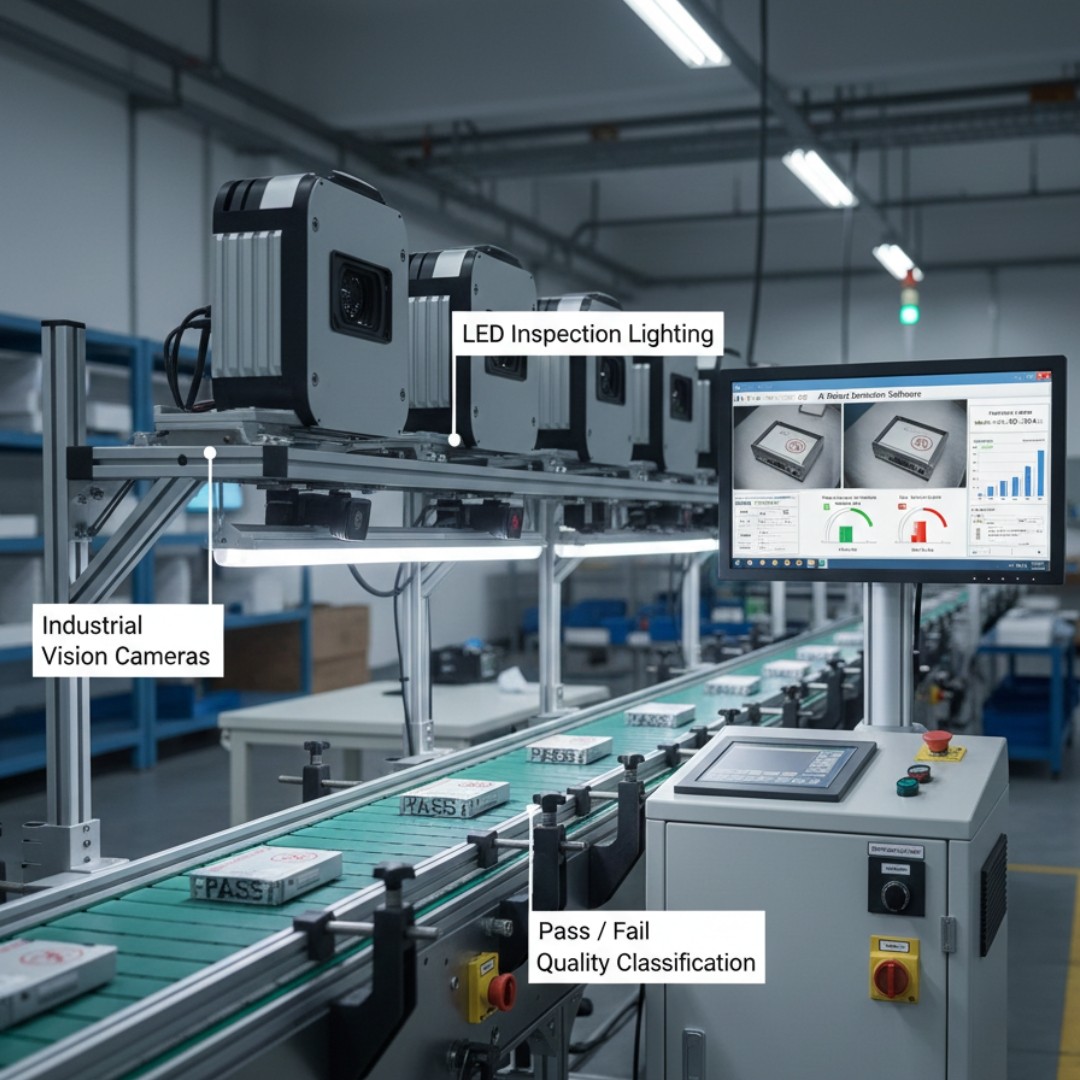
A modern visual inspection machine combines industrial-grade cameras, controlled lighting, and intelligent software into a single inspection unit. These machines capture detailed images and analyse them in milliseconds using trained AI models.
Multiple machines working together form visual inspection systems that integrate directly with production lines. A vision inspection machine operates continuously, providing real-time feedback without interrupting workflow.
In industrial settings, these systems are designed to perform reliably under demanding conditions while maintaining consistent inspection standards.
Industrial Visual Inspection in Modern Production
Industrial visual inspection is increasingly used in manufacturing environments where speed, precision, and consistency are essential. In processes involving metals, electronics, textiles, or packaged goods, defects may be subtle and irregular.
AI-driven inspection systems excel in these conditions by evaluating every unit under the same criteria. Continuous inspection helps manufacturers detect issues earlier, respond faster to process changes, and maintain tighter control over quality.
Reducing Errors While Preserving Human Expertise
Human inspection errors are not a reflection of skill, but a result of natural limitations. Repetition, long shifts, and visual strain affect even the most experienced inspectors.
Visual Inspection AI helps reduce these limitations by handling repetitive inspection tasks consistently. Because AI systems inspect every product rather than samples, the likelihood of missed defects is significantly reduced.
At the same time, human expertise remains critical. Quality professionals interpret results, investigate root causes, and guide process improvements-ensuring that inspection remains both accurate and meaningful.
Why Manufacturers Are Shifting Toward Automated Visual Inspection
Across industries, manufacturers are increasingly shifting their focus from manual inspection toward automated, AI-driven inspection systems.
This transition is driven by:
Increasing production volumes
Higher customer expectations for quality
Workforce constraints
The need for inspection data and traceability
A visual inspection system in manufacturing industries aligns well with these demands by delivering scalable inspection, consistent results, and actionable data that supports continuous improvement.
The Emerging Quality Model: AI-Supported, Human-Led
The most effective quality strategies today combine intelligent systems with human oversight.
AI performs continuous inspection at scale.
Humans focus on validation, analysis, and improvement.
This balance allows manufacturers to maintain quality standards while adapting to evolving production requirements.
Conclusion
The shift from human inspection to intelligent visual inspection systems reflects a broader transformation in manufacturing. As products become more complex and production speeds increase, traditional inspection methods alone are no longer sufficient.
Visual Inspection AI offers a practical way to improve consistency, reduce uncertainty, and support scalable quality control-without removing human insight from the process.
Within this evolving landscape, platforms such as AegisVision focus on enabling visual inspection through computer vision and machine learning in industrial settings. By supporting continuous inspection and providing clearer visibility into production processes, such approaches contribute to how manufacturers are modernizing quality control.
As manufacturing continues to evolve, intelligent visual inspection is becoming an integral part of building reliable, data-informed quality systems for the future.
FAQs
1. How does visual inspection AI improve quality in manufacturing?
It inspects every product consistently, reducing variability and lowering the risk of missed defects compared to sampling-based manual inspection.
2. What role does a visual inspection machine play on the production line?
It captures and analyses product images in real time, supporting continuous inspection without slowing production.
3. How do visual inspection systems support industrial environments?
They are designed to operate reliably in high-speed, demanding conditions while maintaining consistent inspection standards.
4. Is manual inspection still needed with AI systems?
Yes. Human oversight remains important for validation, interpretation, and ongoing process improvement.
5. Why are visual inspection systems increasingly adopted across manufacturing industries?
They offer scalable inspection, consistent results, and data that supports long-term quality improvement.